
For most of the world, Everest is Nepal in miniature, a single peak standing in for an entire country’s identity. But Everest is only the most famous entry in a much larger story. Nepal is home to eight of the world’s fourteen mountains taller than 8,000 meters, an extraordinary concentration found nowhere else on Earth, packed into a country roughly the size of a mid-sized U.S. state.
This guide walks through those eight giants, the regions that hold them, the history behind their first ascents, and the peaks that don’t make the height list but matter just as much to Nepal’s identity.
Table of Contents
1. What Makes a Mountain an “Eight-Thousander”?
2. Why Nepal Holds So Many of Them
3. Nepal’s Eight Highest Peaks
4. Where These Mountains Cluster
5. The Story Behind the First Ascents
6. Peaks That Don’t Make the List, But Should
7. How Ordinary Travelers Experience These Mountains
8. The Deeper Significance of These Peaks in Nepali Life
9. Common Misunderstandings About Nepal’s Mountains
10. Conclusion
1. What Makes a Mountain an “Eight-Thousander”?
The term “eight-thousander” refers to any of the fourteen mountains on Earth that rise above 8,000 meters, all of them concentrated in just two mountain systems: the Himalaya and the Karakoram. These aren’t simply the world’s tallest peaks by a technicality, they represent a genuinely different category of mountaineering, where altitude itself becomes one of the primary dangers, regardless of a climber’s skill or experience.
Reaching this height means climbing into what mountaineers call the “death zone,” the altitude above roughly 8,000 meters where oxygen is so thin that the human body can no longer acclimatize, and instead begins slowly deteriorating the longer it stays there. Every eight-thousander demands respect for this fact, no matter how well-traveled its base camp has become.
2. Why Nepal Holds So Many of Them
Nepal’s disproportionate share of these giants comes down to geology and geography combined. The country sits along the most active, most dramatically uplifted stretch of the entire Himalayan range, formed by the ongoing collision of the Indian and Eurasian tectonic plates, a slow-motion crash that continues to push these mountains higher even today.
Unlike some mountain ranges where high peaks are spread thin across a continent, Nepal’s eight-thousanders sit relatively close together, clustered into a handful of distinct regions. That geographic concentration is part of what has made Nepal, rather than its neighbors, the historic center of world mountaineering.
3. Nepal’s Eight Highest Peaks
| Peak | Height | Region | First Climbed |
| Mount Everest | 8,849m | Khumbu, near Solukhumbu | 1953 |
| Kangchenjunga | 8,586m | Eastern Nepal, Taplejung | 1955 |
| Lhotse | 8,516m | Khumbu, beside Everest | 1956 |
| Makalu | 8,485m | Eastern Nepal, Sankhuwasabha | 1955 |
| Cho Oyu | 8,188m | Khumbu, near the Tibet border | 1954 |
| Dhaulagiri | 8,167m | Western Nepal | 1960 |
| Manaslu | 8,163m | Gorkha district | 1956 |
| Annapurna I | 8,091m | Annapurna region | 1950 |
Between them, these eight mountains represent well over a century of combined mountaineering history, and account for a majority of the world’s total eight-thousanders in a single country.
4. Where These Mountains Cluster
Everest and Lhotse rise side by side in the Khumbu region, the most visited high-altitude area in the country, reached by a short flight to Lukla and a multi-day approach on foot. This is the region most people picture when they think of Nepali mountaineering, and for good reason, it’s home to the single most famous mountain on Earth.
Kangchenjunga sits far to the east, in one of Nepal’s least-visited corners, partly because of its remoteness and partly because local tradition treats its summit as sacred, leading many expeditions to stop just short of the true top out of respect. Makalu shares that same remoteness, tucked only a few valleys from Everest yet visited by a fraction of the trekkers.
To the west, Dhaulagiri and Annapurna rise across from each other in the Gandaki region. Annapurna, despite being the shortest of Nepal’s eight-thousanders, carries one of the most serious reputations of any mountain in the world. Manaslu, in nearby Gorkha district, has grown steadily as a quieter, increasingly popular alternative to the more crowded routes on Everest and Annapurna.
5. The Story Behind the First Ascents
The race to climb the world’s highest peaks unfolded over roughly a decade, and Nepal’s mountains sat at the very center of it. Annapurna was the first to fall, climbed in 1950 by a French team under conditions so difficult that the climbers barely survived the descent. Everest followed in 1953, achieved by a British-led expedition and forever tied to the names Edmund Hillary and Tenzing Norgay. Within just a few more years, Kangchenjunga, Lhotse, Makalu, Cho Oyu, and Manaslu had all been climbed as well, with Dhaulagiri, one of the most technically difficult of the group, finally falling in 1960.
That entire era, arguably the most significant decade in mountaineering history, played out almost entirely on Nepali soil, a fact that still shapes how the country is seen by climbers and travelers alike.
6. Peaks That Don’t Make the List, But Should
Height alone doesn’t capture everything that matters about Nepal’s mountains. Several peaks below the 8,000-meter threshold are just as central to how people experience the Himalaya.
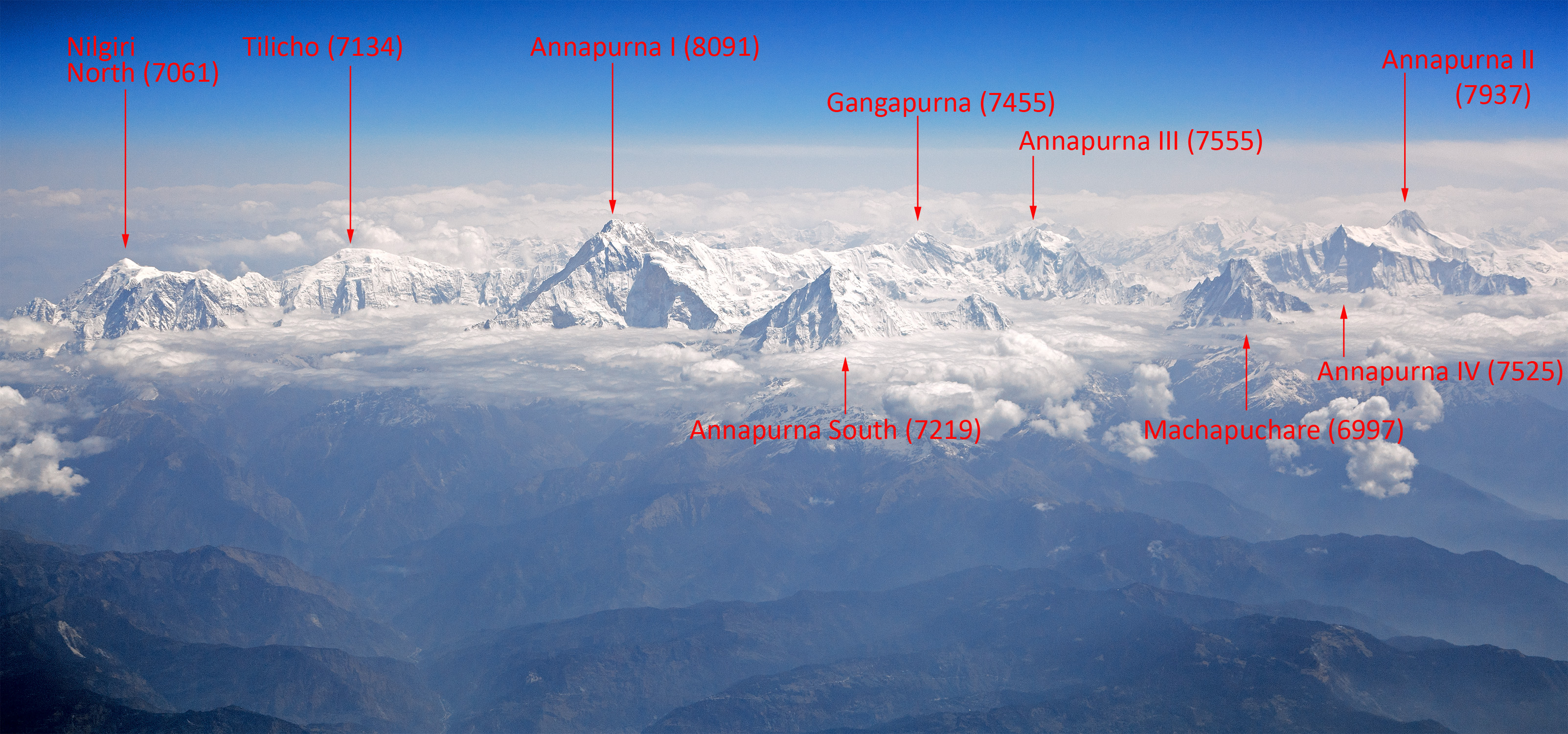
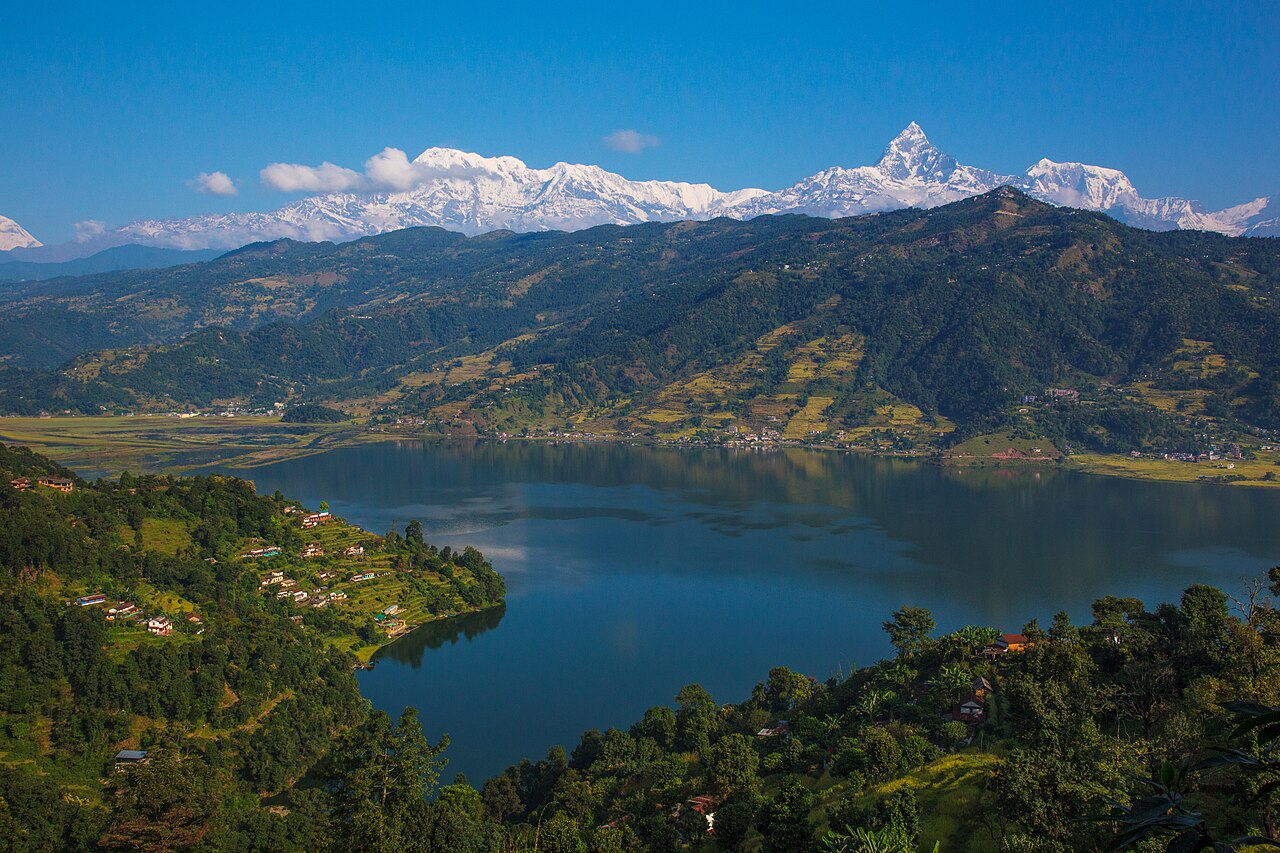
Ama Dablam, though far shorter than any eight-thousander, is arguably the most photographed mountain in Nepal, prized for its dramatic, spire-like shape rising above the Everest region’s trekking trails. Machapuchare, known as the Fishtail for its distinctive twin-pointed summit, is considered sacred and has never been officially climbed, one of the very few major peaks in the world that remains untouched by design rather than difficulty.
These peaks are reminders that a mountain’s significance in Nepal isn’t only measured in meters.
7. How Ordinary Travelers Experience These Mountains
Very few visitors to Nepal ever attempt to climb an eight-thousander, and none of them need to in order to experience these mountains meaningfully. Standard trekking routes bring travelers within close, direct sight of several of these giants without requiring any technical climbing at all.
The Everest Base Camp trek places trekkers at the foot of Everest, Lhotse, and their neighboring peaks. The Annapurna Circuit and Annapurna Base Camp routes wind directly through the Annapurna massif, alongside Machapuchare. The quieter Manaslu Circuit circles the eighth-highest mountain on Earth with a fraction of the foot traffic of its more famous counterparts. For most travelers, this kind of proximity, walking for days within view of an 8,000-meter peak, is more than enough.
8. The Deeper Significance of These Peaks in Nepali Life
For Nepal, these mountains are far more than a backdrop for photographs or a target for foreign expeditions. Many are considered sacred, home to deities, or treated as living presences woven into local belief systems long before mountaineering existed as a sport. Machapuchare’s permanently unclimbed status reflects this directly, and even peaks that are regularly climbed, like Kangchenjunga, carry customs of respect that shape how expeditions approach their summits.
These mountains are also the literal foundation of Nepal’s modern economy. Mountaineering and trekking tourism, built almost entirely around this same handful of peaks, form one of the country’s most important industries, supporting guides, porters, lodges, and entire mountain communities whose livelihoods trace directly back to these summits.
9. Common Misunderstandings About Nepal’s Mountains
Assuming height determines danger: Annapurna, the shortest of Nepal’s eight-thousanders, is widely regarded as more dangerous to climb than much taller peaks like Cho Oyu, proof that a mountain’s difficulty depends on far more than its elevation.
Assuming every major peak has been climbed: Machapuchare remains deliberately unclimbed, a reminder that not every summit in Nepal is a mountaineering objective.
Assuming you need to be a climber to see these mountains: most travelers who come within sight of an eight-thousander are trekkers on foot trails, not mountaineers on technical routes.
Assuming these mountains are only a tourist attraction: for many Nepali communities, these peaks carry religious and cultural weight that predates, and exists independently of, the tourism industry built around them.
10. Conclusion
Nepal’s eight-thousanders are more than a list of statistics, they represent nearly the entire modern history of high-altitude mountaineering, compressed into a single, small country. From Annapurna’s first ascent in 1950 to Everest’s enduring global fame, these peaks have shaped how the rest of the world understands both extreme adventure and Nepal itself.
Whether the goal is to summit one of these giants, trek within sight of one, or simply understand why they matter so much to the people who live in their shadow, Nepal’s highest mountains offer something no other country can fully replicate, a landscape where the world’s most extreme peaks are simply part of everyday life.



'/></svg>)